DIVE MASTER DIVE PLAN Strawberry Reservoir — Soldier Creek Basin, UT
01 — DIVE PLAN OVERVIEW
Site | Date of Plan | Dive Master (Candidate) | Instructor |
Strawberry Reservoir Soldier Creek Basin, UT | April 2026 | Chris Roper | Jamie Peterson / Neptune Divers |
Group Size | Suggested Cert Level | Dive Type | Altitude |
N/A | SSI Advanced Open Water or higher | Shore dive — freshwater — altitude | 7,602 ft — altitude protocols mandatory |
Site Selection Rationale
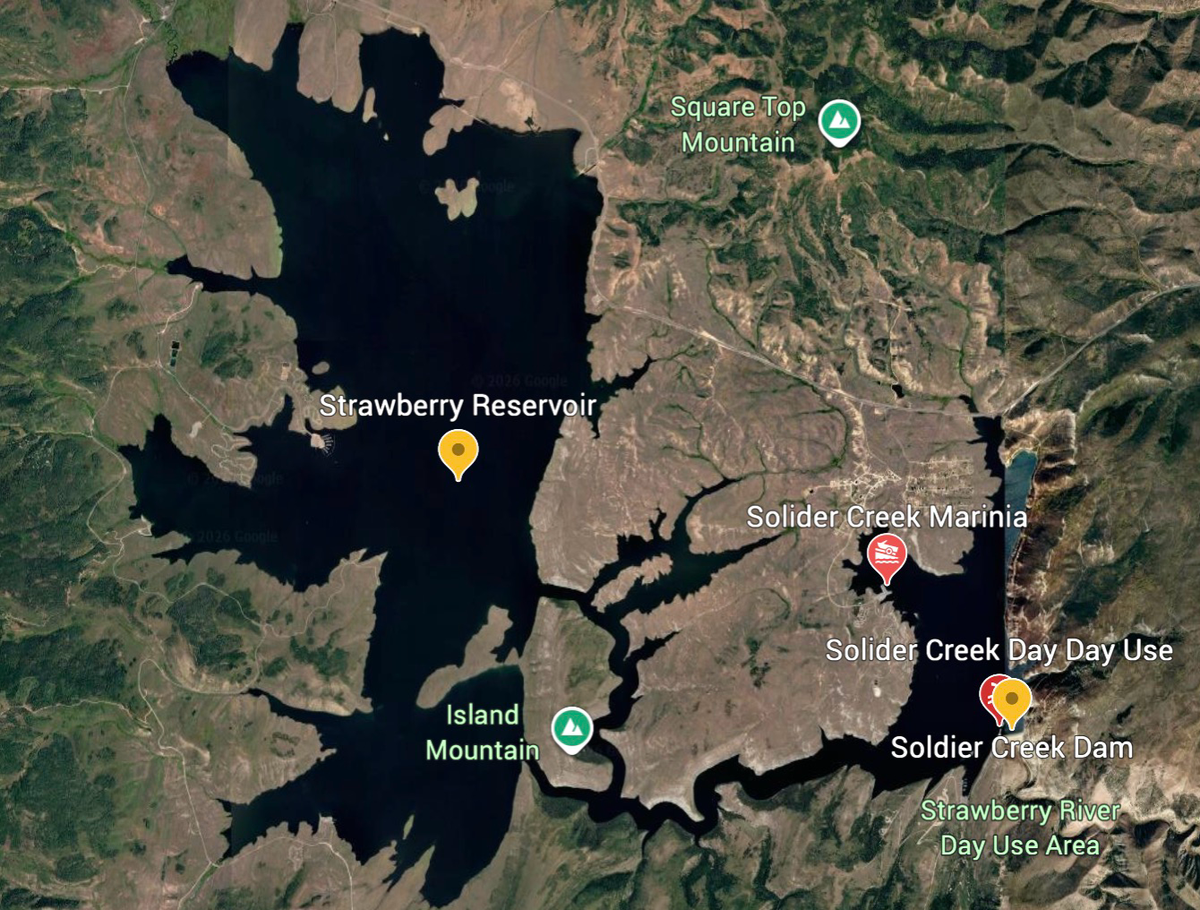
Soldier Creek Basin is selected as the primary dive site. It is the deepest section of Strawberry Reservoir — reaching a maximum depth of approximately 200 feet — and offers the most technically interesting terrain: the Stinking Springs thermal feature, rocky drop-offs, submerged shoreline structure along the eastern shelf, and reliable kokanee schooling habitat. Entry is from the Soldier Creek Dam Day Use Area at the south end of the basin — confirmed GPS coordinates N 40.137402° W 111.029375° at 7,533 ft elevation. The route follows the eastern shoreline north through the Soldier Creek channel. The site is appropriate for an Advanced-certified group.
⚠ CRITICAL | · Altitude dive at 7,602 ft — all computers must be set to altitude mode before entry. · NDLs are shorter than sea level. 40 ft actual depth = ~56 ft theoretical ocean depth. · No flying within 24 hours of diving. · Water temperature ~33–36°F — drysuit or 7mm+ wetsuit mandatory. · Soldier Creek Basin reaches 200 ft — we are diving to 40 ft MAX. · Watch your depth gauge at all times. |
02 — SITE INFORMATION & ENVIRONMENTAL CONDITIONS
Site Overview
Parameter | Detail |
Location | Soldier Creek Dam Day Use Area — 23 mi SE of Heber City on US-40 |
Coordinates | N 40.137402° W 111.029375° — Soldier Creek Dam Day Use Area (verified GPS) |
Elevation | 7,602 ft (2,317 m) — altitude dive protocols required |
Water Temp (Apr) | 33–36°F (1–2°C) — extreme cold, hypothermia risk |
Visibility | 8–15 ft (seasonal runoff; best late summer–fall) |
Site Max Depth | ~200 ft (Soldier Creek Basin) — WE DIVE TO 40 FT MAX |
Our Planned Depth | 40 ft actual (~56 ft theoretical ocean depth at altitude) |
Bottom Composition | Rocky shoreline, silty basin floor, submerged structure |
Current | None significant |
Access | Soldier Creek Dam Day Use Area — shore entry at south end of Soldier Creek Basin |
Facilities | Restrooms, parking, picnic area at Soldier Creek complex |
Entrance Fee | Uinta National Forest — pay before diving |
Boat Traffic | Active motorized watercraft — dive flag mandatory |
Seasonal Diving Conditions — Monthly Reference
This plan is designed to be used year-round. Adjust environmental conditions, equipment requirements, and SAC expectations based on the season at the time of the dive. The reservoir is closed to diving when ice is present (approximately December–April, depending on the year).
Month | Surface Temp | Visibility | Exposure Suit | Conditions & Notes |
Nov – Mar | 32°F (ice) | N/A | N/A | CLOSED — Reservoir ices over mid-December. Ice typically clears mid-May depending on snowpack. |
April | 33–36°F | 8–15 ft | Drysuit mandatory | Ice-off period. Isothermal — same near-freezing temp top to bottom, no thermocline. High hypothermia risk. Expect elevated SAC. Fish active and shallow post ice-off. Low boat traffic. |
May | 48–57°F | 2–8 ft | Drysuit or 7mm+ | Worst visibility of the year — snowmelt runoff peaks. Avoid if possible. Water warming but runoff suspends sediment throughout water column. No thermocline yet. |
June | 55–65°F | 10–20 ft | 7mm wetsuit | Transitional. Thermocline establishing around 20–30 ft — warm above, cold below. Visibility improving as runoff settles. Boat traffic picking up. Fish begin moving deeper. |
Jul – Aug | 63–72°F | 15–25 ft | 5mm wetsuit | Best overall conditions. Well-established thermocline at 20–30 ft — warm above, near-freezing below. Best visibility of the year. Heavy boat traffic — dive flag critical. Fish school deeper. Summer thunderstorms possible — check forecast. |
September ★ | 63–72°F | 15–25 ft | 5mm wetsuit | BEST MONTH. Warm water, excellent visibility, thermocline still present. Boat traffic drops sharply after Labor Day. Fish move shallower as surface cools. Optimal combination of temperature, visibility, fish activity, and low traffic. |
October | 50–60°F | 10–20 ft | 7mm or drysuit | Cooling rapidly. Thermocline breaking down. Visibility still good. Fish active and shallow. Low boat traffic. Drysuit recommended from mid-October. Last viable wetsuit diving window. |
★ September is the recommended month for this dive site. Best combination of water temperature, visibility, fish activity, and reduced boat traffic. Update environmental conditions, exposure suit requirements, and SAC estimates in this plan to reflect actual conditions at time of dive.
03 — SITE HISTORY, FEATURES & MARINE LIFE
Reservoir History
• Strawberry Reservoir sits at 7,602 ft in the Uinta-Wasatch-Cache National Forest — one of the highest-elevation dive sites in Utah and one of the largest reservoirs in the American West by volume. • The original Strawberry Dam was built between 1906 and 1913 as one of the first large-scale trans-mountain water diversions in the western United States — an engineering feat of its era, channeling Colorado River Basin water to Utah Valley farmland through a 3.8-mile tunnel hand-dug through the mountain. • That original dam was deliberately breached in 1985. The dam you see today — Soldier Creek Dam — was built between 1970 and 1974, stands 272 feet tall, and expanded the reservoir from 283,000 acre-feet to over 1,106,500 acre-feet. The basin we're diving in IS the old Soldier Creek Reservoir that was flooded when the new dam was built. • We're literally diving in a valley that was dry land-living memory ago. The submerged shoreline structure, rock formations, and irregular bottom we'll explore are remnants of that original landscape. • Strawberry receives over 1.5 million angling hours annually and is Utah's premier Blue-Ribbon Fishery — the most coveted designation in freshwater fishing. The water quality exceeds standards, which is exactly why we'll have good visibility even at depth. |
Stinking Springs — The Thermal Feature
• Stinking Springs is a natural underwater spring system within the Soldier Creek Basin — one of the most interesting features we'll potentially encounter on this dive. • Spring water percolating through limestone and volcanic rock creates a localized temperature differential — slightly warmer water in an otherwise ice-cold reservoir. That warmth and the mineral-rich water it carries draws fish, particularly in cold months when the rest of the lake is frigid. • The springs create visible distortion in the water column — similar to a heat shimmer — where warmer spring water meets the colder reservoir. If you see what looks like 'wavy' water near the bottom, that's the spring interface. Do not disturb the silt around the springs — visibility will collapse instantly. • The name 'Stinking Springs' comes from hydrogen sulfide in the spring water — a mild sulfur smell that's completely harmless but unmistakable if conditions are right. You may notice it on ascent near the spring zone. • This is a rare feature in Utah freshwater diving. Very few reservoirs in the state have accessible thermal spring features at recreational depths. |
Fish & Wildlife — What to Expect
Species | What to Know & Where to Look |
Bear Lake Cutthroat Trout
| The star of Strawberry. These fish can exceed 24 inches and have been documented up to 27 lbs. historically. In April at ice-off, they move into the warming shallows to feed on leeches, scuds, and snails — exactly the depth range we're diving. Expect them to cruise the rocky shoreline structure between 10–30 ft. They are bold and curious — if you hold still, they will approach within arm's reach. Do not touch. |
Sterilized Rainbow Trout
| Stocked by Utah DWR as sterile fish so they don’t cross with pure-strain cutthroats. They grow fast and fat. Rainbows hold near submerged structure — specifically the outer edge of aquatic weed beds, rocky points and drop-offs where the original valley walls meet the reservoir floor, and boulder/rubble fields where they use the rocks as current breaks. Look for them hovering just above these transition zones in the 15–30 ft range, typically within a foot or two of the bottom. Watch for any place where rock meets silt, where weeds end, or where the bottom changes angle — that’s where rainbows hold. Chunky, muscular fish — memorable to see underwater. |
Kokanee Salmon
| Landlocked sockeye salmon first introduced to Strawberry in 1937. Soldier Creek Basin is the sweet spot for kokanee — they school in open water mid-column. At depth in April, they'll be concentrated in the thermocline area. Watch for tight silver schools — the flash of 50+ kokanee banking together in cold clear water is something you don't forget. |
Crayfish (Crawdads)
| Common throughout the rocky shoreline areas of Soldier Creek. They tuck under rocks and in crevices along the bottom structure. Best encountered by slowly approaching rocky patches at 10–20 ft and looking into crevices. They will emerge and 'display' if you hover patiently. Active year-round regardless of water temp. A favorite of local divers. |
Utah Chub (non-game)
| Smaller schooling fish you'll likely see near the bottom. Not the stars of the show but often swim in large groups that add to the underwater scene. The DWR actively manages their population using cutthroat trout as natural predators. |


Where to Find Fish & Crawdads — By Depth Zone
Depth Zone | Expected Species & Notes |
0–15 ft | Entry/exit zone. Crayfish under rocks along shoreline. Rainbow trout near structure. Cutthroat cruising into feed — especially in April post ice-off when fish push shallow. |
15–30 ft | Primary fish zone on this dive. Best cutthroat and rainbow encounters. Rocky bottom transitions to mixed rock/silt — prime crayfish habitat. Look into every crevice. |
30–40 ft (max) | Deeper structure and open-water edges. Kokanee schools may be visible mid-column above this depth. Silt bottom increases — good buoyancy critical here. Approaching our turn depth. |
40 ft+ | Below our planned depth — site continues to 200 ft. Monitor depth gauge — the bottom drops away and can be deceptive in clear water. Do not follow fish deeper. |
Spearfishing — Is It Allowed?
NO | Strawberry Reservoir is NOT on Utah's approved list of waters open to underwater spearfishing (Utah Admin. Rule R657-13-9). Spearfishing is prohibited at this site regardless of license status. Standard fishing regulations apply to anglers on the surface. Divers may observe fish but may not take them by any method while diving at Strawberry Reservoir. Crayfish: Utah allows taking crayfish by hand while diving at open waters — verify current DWR regulations before the dive. |
04 — DIVE PROFILE & NAVIGATION PLAN
Planned Dive Profile
Site Max Depth | Our Max Depth | Max Time | Safety Stop |
~200 ft (Soldier Creek Basin) WATCH YOUR GAUGE | 40 ft actual (~56 ft TOD at altitude) | 45 min or NDL — whichever first | 15 ft / 3–5 min — MANDATORY |
Altitude Depth Conversion Table
At 7,602 ft elevation, actual depths must be converted to Theoretical Ocean Depth (TOD) for table planning:
Actual Depth | TOD (≈ 7,600 ft) | Approx NDL (air) | Use For Tables As |
15 ft | 21 ft | Unlimited | 20 ft |
20 ft | 28 ft | Unlimited | 30 ft |
30 ft | 42 ft | ~100 min | 40 ft |
40 ft ← OUR MAX | 56 ft | ~50 min | 60 ft |
60 ft | 84 ft | ~20 min | 90 ft |
Navigation Plan
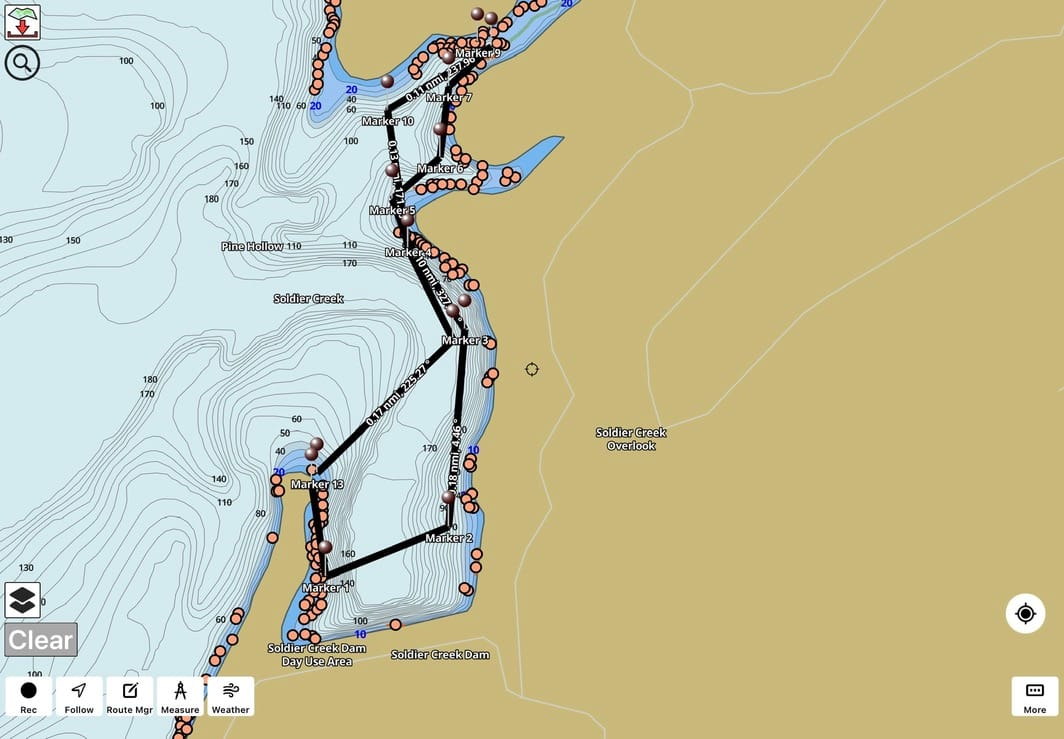
Dive sequence from Soldier Creek Dam Day Use Area (N 40.137402° W 111.029375°):
Phase 1 — Entry | Gear up at vehicle at Soldier Creek Dam Day Use Area parking (N 40.137402° W 111.029375°). Full RAWFISH buddy checks at water’s edge. Don fins in shallows. Surface signal OK before descent. Deploy dive flag on SMB. Mark GPS entry point on your computer before submerging. |
Phase 2 — Descent | Controlled descent along rocky slope. DM leads. Target 15–20 ft initially — hold briefly to confirm all divers equalized and computers reading correct altitude-adjusted depth. |
Phase 3 — Exploration | Proceed to 30–40 ft along the eastern shoreline shelf trending north through the Soldier Creek Basin channel. Route follows the eastern bank structure as shown on Navionics chart — depth contours drop sharply to 170–180 ft in the channel center; stay on the eastern shelf in the 20–60 ft zone. 15–20 min northward swim following the shoreline. DM holds front, checks buddy pairs every 2–3 min. Watch depth gauge — the channel floor drops away steeply to the west. |
Phase 4 — Turn | At 2,000 PSI or 20-min elapsed time (whichever first), DM signals turn. Group reverses course ascending gradually back toward entry slope. |
Phase 5 — Ascent | Controlled ascent max 9 m/min. At 15 ft — full stop, 3–5 min mandatory safety stop. All divers hold together. |
Phase 6 — Exit | Surface together. Inflate BCDs. DM confirms all divers before exit. Single file exit at entry point. Doff equipment at water's edge. |
05 — Gas Management Plan
Rule of Thirds — Gas Policy
Starting PSI | Turn Pressure | Minimum Surface | Emergency Reserve |
3,000 PSI (full) | 2,000 PSI | 1,000 PSI | 500 PSI — abort dive |
Cold water significantly increases SAC rate — expect 20–30% higher gas consumption than warm-water equivalent dives. DM will conduct gas checks at descent, at turn point, and at safety stop. Any diver reaching 1,500 PSI signals DM immediately — group ascends together.
Hand Signals — Review Required Pre-Dive
Signal | Meaning |
Cutting or chopping throat with flat hand
| Out of air — emergency |
Flat hand, palm down, moved slowly up and down
| Take it easy / slow down — approaching reserve |
Circle made with thumb and forefinger, remaining fingers extended
| Gas sufficient — all good |
Fist with thumb extended upward, hand moved upward | Ascend now — no discussion |
3 tank bangs | Emergency recall — ascend immediately |


06 — RAWFISH BUDDY CHECK (NEPTUNE DIVERS STANDARD)
All buddy teams complete RAWFISH before entry. DM verifies each team.
No one enters the water until all checks are confirmed.
| Component | What to Check |
R | Regulator Check | Confirm air is flowing from the regulator. Check that the mouthpiece is secure and not cracked or loose. Both divers breathe from their primary regulator to confirm function. |
A | Air | Confirm air is turned on. Share starting PSI with buddy verbally — e.g. “I have 3,000 PSI.” Buddy confirms their PSI in return. Both log starting pressures on dive slate. |
W | Weights | Confirm weights are secure and will not shift during the dive. Share with buddy how much weight you have and exactly where it is on your BCD — e.g. “I have 8 lbs., integrated pockets, right and left.” Buddy confirms they can locate and release your weights in an emergency. |
F | Fins | Diver confirms fins are on, straps are secure and vocalizes to their buddy — e.g. “Fins on and secure.” Buddy visually confirms. Check fin straps are not twisted, and heel straps are fully seated. |
I | Inflator | Diver tests BCD inflator — press fill button and confirm BCD inflates, press dump and confirm it deflates. Double-check that the low-pressure inflator hose is tight and fully seated at the BCD connection. Buddy observes and confirms. |
S | Secure | Diver double-checks all BCD buckles and strap tightness. Check all gear attached to the BCD — SPG, alternate air source, dive light, SMB — confirming each is properly clipped, tucked, and streamlined. Buddy does a visual sweep of the entire rig. |
H | Hand Signals | Diver and buddy review and verify hand signals with each other — both demonstrate each signal to confirm mutual understanding before entering the water. At minimum: OK, ascend, descend, stop, low on gas, out of gas, problem, and recall signal. |
07 — EQUIPMENT REQUIREMENTS
Individual Diver Equipment | Group / DM Equipment |
• Drysuit OR 7mm+ wetsuit (drysuit strongly preferred at ~34°F) • Hood, gloves, and boots — mandatory • BCD with integrated weight or weight belt • Regulator with SPG and alternate air source • Dive computer — altitude mode capable — SET BEFORE ENTRY • Mask, fins, snorkel • Surface marker buoy (SMB) — each diver • Dive light (recommended — reduced vis conditions) • Compass — navigation in low visibility • Dive knife or shears | • O₂ kit — demand valve + NRB mask (red bag at vehicle) • First aid kit — dive-specific EDC kit at shore entry point • Garmin inReach Mini — on DM person in waterproof Garmin case • Mobile phone — fully charged, in vehicle at parking area • Dive flag — deployed at surface throughout entire dive • Underwater slate and pencil — DM navigation notes • Save-a-dive kit — O-rings, fin straps, mask strap, mouthpiece • Dive log sheets — pre-filled for all divers • DAN card and emergency contact list |
08 — SAFETY & EMERGENCY ACTION PLAN
Emergency Equipment Locations
Item | Location / Detail |
O₂ Kit | Red bag, passenger seat of DM vehicle — demand valve + NRB mask + tubing |
First Aid Kit | Dry bag at shore entry point — dive-specific EDC kit |
Garmin inReach Mini | ON DM's person in Garmin waterproof case at all times — primary emergency comms |
Mobile Phone | In vehicle at parking area — used once DM reaches exit area after SOS activation |
Emergency Contacts | DAN: +1-919-684-9111 | 911 | Wasatch County Dispatch: 435-654-1411 |
Nearest Hospital | Heber Valley Hospital — 1485 S Highway 40, Heber City — ~25 min |
Hyperbaric Chamber | University of Utah Hospital, Salt Lake City — ~90 min |
Responsible Party | Chris Roper (DM Candidate) directs all emergency procedures |
Emergency Communications Protocol
PROTOCOL | Step 1 — On reaching the surface with an emergency: DM activates inReach SOS immediately. This triggers the GEOS International Emergency Response Center and dispatches rescue — faster than a phone call. Step 2 — DM manages diver safety at the exit area while rescue response is activated. Step 3 — Once the group reaches the vehicle/exit area, DM calls 911 to provide precise location, confirm inReach SOS is active, and relay medical information to responders. Rationale: inReach SOS activates the emergency system the moment the DM surfaces — no delay waiting for cell signal or reaching the vehicle. Phone call follows to provide detail and confirm response is en route. |
Emergency Action Sequence
1. STOP — Establish positive buoyancy on the diver. Inflate BCD. Remove weights if necessary.
2. SIGNAL — Alert other divers. DM takes command. Clear water, get diver to shore.
3. ASSESS — Check responsiveness, breathing, pulse. Begin CPR if indicated.
4. O₂ — Administer O₂ immediately for suspected DCS, near-drowning, or loss of consciousness.
5. SOS — DM activates Garmin inReach SOS immediately upon surfacing with emergency.
6. CALL 911 — Once at vehicle/exit area, call 911 to confirm location and relay medical info. Advise the dispatcher of the injury type. See Section 8.4 — Air vs. Ground Transport Protocol to determine whether to request Life Flight or ground transport.
7. DAN — Call DAN at +1-919-684-9111 for DCS assessment and hyperbaric referral.
8. DOCUMENT — Record dive profile, time of incident, symptoms, and all actions taken.
Section 8.4 — Air vs. Ground Transport Protocol
Key Reference Points:
Facility | Contact / Dispatch | Est. Response |
Life Flight (Provo) | 911 or 1-800-321-1911 | ~15–20 min flight once airborne |
Heber Valley Hospital | 911 (ground EMS dispatch) | ~25 min by ground |
U of U Hyperbaric (SLC) | DAN: +1-919-684-9111 | ~90 min by ground |
REQUEST LIFE FLIGHT — Call 911 and explicitly state “Request Life Flight helicopter.”
Cardiac & Respiratory:
● Cardiac arrest — CPR in progress. Request Life Flight immediately. Do not stop CPR.
● Unconscious with pulse but not breathing — Life Flight + rescue breathing.
● Severe respiratory distress — coughing blood, frothy sputum, or unable to speak in full sentences.
● Suspected arterial gas embolism (AGE) — sudden unconsciousness, seizure, or stroke-like symptoms within minutes of surfacing. Time critical: mortality drops dramatically with rapid recompression.
Neurological:
● Unconscious or unresponsive after surfacing.
● Seizure at any point before, during, or after the dive.
● Paralysis or inability to move any limb.
● Sudden vision loss or blindness.
● Confusion or disorientation that does not clear within 5 minutes of surfacing and O₂ administration.
Severe DCS — Type II:
● Any neurological symptom combined with joint pain.
● Loss of bladder or bowel control.
● Weakness or paralysis in any limb.
● Inability to walk or stand unassisted.
Trauma:
● Suspected spinal injury — do not move the patient without guidance from Life Flight paramedics.
● Head trauma with loss of consciousness.
● Open fracture or severe crush injury.
● Suspected internal bleeding — rigid abdomen, rapid deterioration in vital signs, altered mental status.
⚠️ DCS + HELICOPTER WARNING | For any DCS patient transported by helicopter: altitude must stay within 1,000 ft of departure elevation (7,602 ft). When calling 911, explicitly state: “Suspected DCS — helicopter must maintain low-level flight and cannot gain altitude.” Call DAN at +1-919-684-9111 immediately — they will advise Life Flight directly on the correct flight profile. |
USE GROUND TRANSPORT — Drive to Heber Valley Hospital (~25 min)
● DCS Type I — joint pain only, no neurological symptoms, diver alert and oriented. Administer O₂, drive to Heber Valley Hospital, call DAN enroute.
● Skin rash or mottling only — diver alert and oriented, no neurological involvement.
● Near-drowning recovered — diver who aspirated water but is now conscious, breathing, and improving. Do not wait to see if symptoms worsen. Transport immediately.
● Lacerations requiring stitches — bleeding controlled, no vascular compromise.
● Suspected fracture — limb intact, no neurovascular compromise, diver stable.
● Ear or sinus barotrauma — pain or hearing loss, no neurological symptoms.
● Fatigue, mild dizziness, or malaise improving with O₂ — diver oriented and ambulatory.
UNCERTAIN — Call DAN First: +1-919-684-9111 (24/7)
Any post-dive symptom where you are unsure of severity — call DAN before choosing transport mode. DAN medics are available 24/7 and will advise on transport method, flight profile, and receiving facility. This is their specialty.
Quick-Reference Decision Table:
Condition | Transport | Destination |
Cardiac arrest | LIFE FLIGHT | U of U / Level I Trauma |
AGE / sudden neuro symptoms | LIFE FLIGHT (low alt) | U of U Hyperbaric |
DCS Type II (neuro / paralysis) | LIFE FLIGHT (low alt) | U of U Hyperbaric |
Unconscious / not breathing | LIFE FLIGHT | U of U / Level I Trauma |
Seizure | LIFE FLIGHT | U of U / Level I Trauma |
Spinal trauma suspected | LIFE FLIGHT | U of U / Level I Trauma |
DCS Type I — joint pain only, stable | GROUND | Heber Valley Hospital |
Near-drowning, recovered and stable | GROUND | Heber Valley Hospital |
Minor trauma / ear or sinus barotrauma | GROUND | Heber Valley Hospital |
Unclear DCS symptoms | CALL DAN FIRST | DAN advises +1-919-684-9111 |
Rule of thumb: When in doubt, request Life Flight. You can cancel an air response if the patient improves. You cannot undo a delay in getting a critical patient to definitive care.
Lost Buddy Procedure
Underwater — stop, look, 360° scan for 1 minute. Signal DM. If not located: controlled ascent as a group. Surface — inflate BCD, signal OK, hold position. DM accounts for all divers before any re-descent. No diver re-enters without DM clearance.
Diver Recall Procedure
Emergency recall: 3 rapid bangs on tank (underwater) or 3 horn blasts (surface). On this signal — stop dive, ascend at safe rate, complete safety stops if gas permits, surface, inflate BCD, swim to exit. Do not search for other divers — DM manages accountability.
Abort Criteria
• Any diver's computer is not confirmed in altitude mode before entry
• Water temperature below 32°F at the surface
• Any diver reports feeling unwell, cold, or uncomfortable before or during the dive
• Visibility drops below 5 ft
• Any diver reaches 500 PSI emergency reserve
• Weather deteriorates — lightning, high winds, heavy chop
• Any medical emergency or equipment failure that cannot be resolved on site
09 — BRIEFING STRUCTURE (SSI 17-CRITERIA MAP)
The pre-dive briefing addresses all 17 SSI Dive Briefing Evaluation criteria in this order:
# | Criterion | Key Points |
1 | Dive Guide Intro | Name, role, group expectations — nobody dives alone |
2 | Site Name & Description | Strawberry Reservoir — Soldier Creek Basin — 7,602 ft — history, old reservoir valley, cold and clear |
3 ⚠ | Environmental Conditions | 34°F water, 8–15 ft vis, altitude protocol, all computers to altitude mode — site is 200 ft deep, we dive to 40 ft max |
4 | Marine Life | Cutthroat trout, rainbow, kokanee, crayfish — depth zones, Stinking Springs — build excitement |
5 | Entry & Exit | Soldier Creek Dam Day Use Area — shore entry & exit — same point — dive flag mandatory |
6 | Max Depth & Time | 40 ft actual / 45 min or NDL — site goes to 200 ft — watch depth gauge |
7 ⚠ | Gas Management | Rule of thirds — turn at 2,000 PSI — review all gas signals |
8 | Type of Dive | Shore dive — altitude — no-deco — mandatory safety stop at 15 ft for 3–5 min |
9 | Special Considerations | Altitude, cold, boat traffic, depth awareness, limited cell — inReach on DM |
10 | Group Control | DM leads descent, sweeps ascent — 6 ft proximity — no solo movement |
11 | Hand Signals | Full review + diver demonstration before entry |
12 | Buddy Teams | Teams A/B/C — RAWFISH checks — gas and cert compatibility confirmed |
13 | Lost Buddy | Stop-look-signal-ascend — surface protocol |
14 | Safety & Risk | Check in on buddy’s location and gas level often |
15 | Recall Procedure | 3 tank bangs or 3 horn blasts — ascend immediately |
16⚠ | Emergency Procedures | Surface → inReach SOS → exit area → 911 → DAN — Heber Valley Hospital — U of U hyperbaric |
17 ⚠ | Equipment Location | O₂ at vehicle, first aid at shore, inReach on DM person — DM is responsible party |
10 — DAY OF CONDITIONS LOG
Utah Post Dive Conditions Report