Mid-Life Didn't Break Me. It Built Me.
From the moment you arrive in this world, someone is measuring you. For the first few decades of your life there is always a next milestone, always a next step, always someone asking what's next. Then you hit mid-life, and for the first time, there isn't.

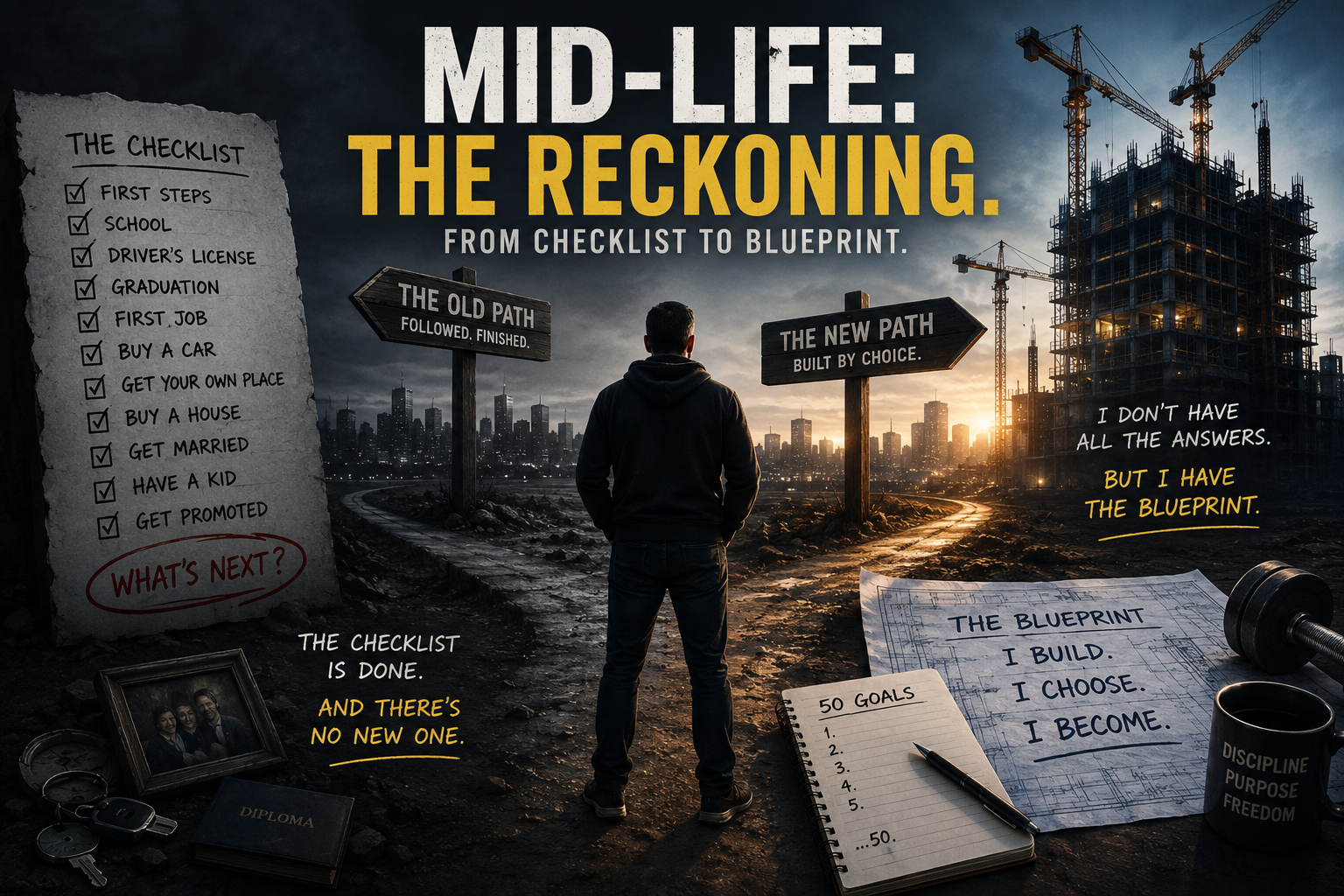
From the moment you arrive in this world, someone is measuring you. Are you hitting the right percentile? Are you the right size? Did you take your first steps on schedule? Then school starts, and every September you level up whether you're ready or not. Puberty comes. You get your driver's license. You graduate. You fall in love for the first time. You get a job, buy a car, get your own place. Maybe you buy a house. Maybe you get married or make a long-term commitment to someone. You get promoted. You have a kid.
Every one of those moments is a milestone. Society hands them to you in sequence, and whether you realize it or not, you spend the first few decades of your life moving through a pre-built framework. The milestones look different from man to man. Not every man gets married. Not every man buys a house or has children. But every man has a set of markers he is moving toward, whether society handed them to him or he built them himself. And for a long time, there is always a next one.
Then you hit mid-life.
For most men, this lands somewhere between 40 and 50, and it often comes without warning. You're just going through your day, and your mind starts to wander. You run through your life like a checklist. Some of the boxes are checked. Some are scratched out because you made a conscious choice, or because life went a different direction. But when you look ahead, something feels wrong.
The checklist is done. And there's no new one.
For the first time in your life, nobody is asking what's next. The markers that quietly structured your entire life have run out. You look forward, and it's empty. You look back, and the regrets start to surface. And for a lot of men, the regret that sits heaviest isn't about money or career or status. It's about themselves. Somewhere along the way, quietly and without a dramatic reason, they stopped making time for who they actually were. Hobbies abandoned. Passions shelved. For some, it was work. For some, it was the kids. For some, it was just a slow numbness that set in without them ever noticing. However it happened, the result was the same. They stopped showing up for themselves, and nobody stopped them from doing it.
That realization is what some people call a midlife crisis. I just call it the reckoning.
I went through this a few years ago. My marriage of 24 years came to an end. I'm not going to dig into the details because that's not the point. What I can tell you is that when it was over, I found myself alone for the first time in decades. I went from living in a 4,000-square-foot house in a beautiful neighborhood to a 700-square-foot apartment downtown. I had always wanted to live downtown, so I told myself it would feel exciting. At first, it didn't feel like anything except frightening.
The apartment was quiet in a way I wasn't prepared for. I had a good job and good friends, but I couldn't shake the weight of it. I felt lost and scared and completely alone, like I was standing in the dark waiting for someone to tell me what to do next. The noise and movement of the city gave me some relief, so I started taking long walks in the evenings just to get out of my own head.
One night I was walking and I stopped in front of a massive construction site. One of those sprawling downtown builds where you can't even see the top of the structure. I stood there looking at it, and a thought hit me from nowhere: I need to rebuild my life. Not fix it. Not salvage it. Build it. The thought was exciting and overwhelming at the same time. But what struck me most was that I had never once thought about my life as something I was building. It had always just been assembling itself around me, milestone by milestone, as long as I followed the path that was laid out.
Standing on that sidewalk, I realized the path was gone. And for the first time, I was holding the blueprint.
But before I could figure out where I was going, I had to get honest about where I was.
I thought I knew. I didn't. When I really looked at myself, I didn't recognize the man I saw. I was carrying over 265 pounds. My mind was loud and scattered. And when I stood in front of the mirror, the question that kept coming back was: Who is this person? From the outside, my life had looked like success. Good job, great neighborhood, cool cars, two incredible sons, fun stories to tell at a party. But strip all of that away, and I didn't know who I was underneath it. I felt like an empty shell. My confidence had been built on what I represented, not on who I actually was.
That kind of honesty is brutal. It is also the only place worth starting from.
I call this phase The Reckoning. A full inventory of your life with no filters and no excuses. Your health, your relationships, your finances, your habits, your beliefs, your regrets. All of it, exactly as it is.
From there, I started thinking about where I actually wanted to go. I made a list of dreams with zero restrictions. No budget. No concern about what anyone would think. No editing for what seemed realistic. The ideas came slowly, and I often felt ridiculous writing them down. I would get caught up in the logistics and convince myself the whole exercise was a waste of time. Looking back, I didn't have the courage to bet on myself. But each time I felt that way, I made one shift. I stopped asking how am I going to do this and started asking how will it feel when I do. I also started thinking about identity. Who is the man capable of doing these things? Do I want to be that man? If the answer was yes, the dream stayed on the list.
One of those dreams was to compete in a bodybuilding competition. At the time, I weighed over 265 pounds. I wrote it down anyway. The list eventually became 50 goals I want to complete by the time I turn 50. Not because I knew how to do all of them, but because seeing them on the page turned a light on inside me. For the first time in a long time, I felt possibility.
I call this The Mission.
Then came the work of closing the gap between where I was and where I wanted to be. Rebuilding my physical health first because many of my goals required it. Then, rebuilding everything else, one decision at a time.
I call this The Rebuild.
None of it felt clean at the start. And if I am being honest, it still isn't always clean. One of my top goals was to get off my CPAP machine. My doctor gave me clear targets to hit: get my body weight below 225, get my BMI below 31. I did the work. I hit the gym. I changed how I ate. After my latest sleep test, I still need the CPAP. So I pivoted. I found a travel CPAP and I kept moving. My bodybuilding goal has hit snags, too, with medication making it harder to get my body fat where it needs to be. Not everything has gone to plan and probably never will.
But here is what I know. I am in the best shape of my life. I have lost over 40 pounds. I have completed 15 of my 50 goals, and I am actively working on most of the rest. The goal was never perfection. It was becoming the man I could see in my mind. Every step toward that man, even the ones that didn't land the way I planned, has been worth it.
These goals have become my new milestones. Not the ones society handed me. Mine.
The emptiness you feel in mid-life is not a sign that something went wrong. It is a sign that the first chapter is finished and the next one is blank. That is not a crisis. That is an invitation.
If you are standing in that void right now, start where I did. Get honest about where you actually are. Not where you thought you'd be. Not where you want to appear to be. Where you actually are. That is the only starting point that matters.
The canvas is blank. You are holding the brush. What are you going to build?
If this resonated with you, stick around. Every week, I publish posts about my 50 by 50 journey, mindset, health, and the occasional book or gear review. No fluff. Just one man figuring it out in real time and sharing everything he learns along the way.
Hit subscribe. It's free and you can unsubscribe anytime. If you want to support the blog, a paid subscription is just $3.00 a month.