What My Marriage Ending Taught Me About Relationships
Sometimes the hardest endings become the beginning of the most important lessons. When my marriage ended after 24 years, I thought I had lost everything that defined me.

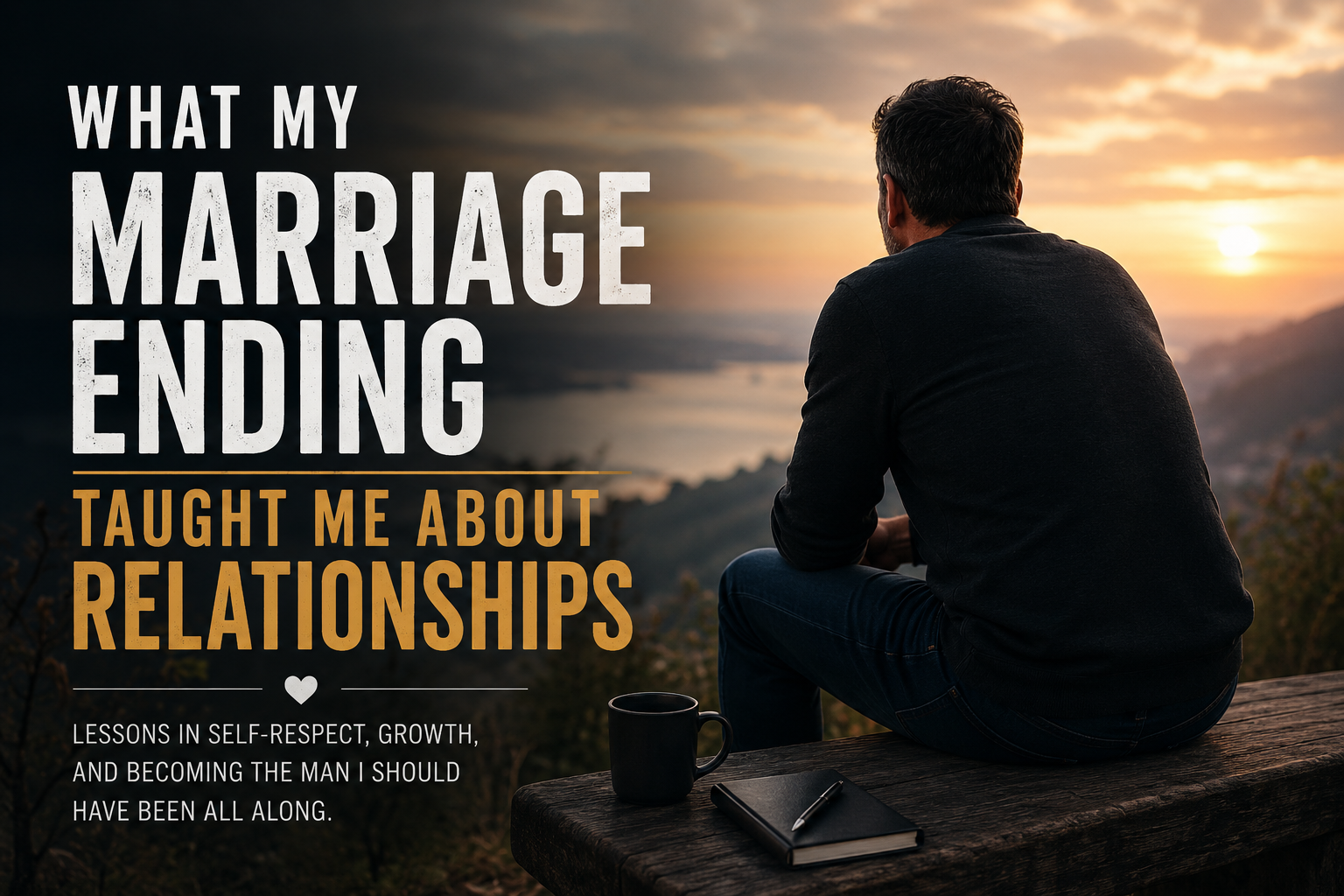
My marriage of 24 years ended. And when it did, I found myself alone for the first time in decades. In a 700-square-foot apartment, quieter than I was prepared for, feeling like a hollow shell of the man I thought I was. I didn't know who I was anymore. And I realized, standing in that silence, how completely I had stopped caring for myself.
When the weight of that settled, I did what I probably should have done a lot earlier. I started paying attention.
I read articles. I read books. I sat across from therapists. I journaled things I had never said out loud. I called friends and had the kind of honest conversations men almost never have. I wasn't looking for someone to blame. I was looking to understand where I had failed and what I would do differently.
Twenty-four years is a long time. There's more to learn from it than I could put in one post. This is just some of what I've found so far.
I am not a relationship expert. I am nowhere close. But I am a man who went through something painful, did the work to understand it, and came out the other side with a few things I wish I had known sooner. This is a work in progress. I'll share more as I keep learning. And if you think I'm off base on any of it, I genuinely want to hear that.
Here's where I've landed so far.
Most relationships don't end in a blowup. They fade. Slowly, quietly, and often without anyone fully noticing until the distance is already there. Two people who once couldn't get enough of each other settling into something that works but doesn't crackle.
Looking back, I don't think that's a love problem. I think it's a priority problem. The heat in a relationship doesn't maintain itself. It doesn't stay because you want it to. It stays because someone, and ideally both of you, keep creating it. Deliberately. Consistently. With intention.
I know these things because I'm doing them now, imperfectly, in real time. Here's what that looks like, at least from where I'm standing.
1. Your partner respects you to the level you respect yourself
This one hit me hard when I finally saw it.
The way your partner sees you is built, in large part, on how you carry yourself. Not your income. Not your title. Not what you look like on paper. Think about the man who stands tall and moves with purpose. Who is gentle and strong at the same time. Who holds space in a room without overwhelming it. Who is welcoming and kind without trying to be. That man doesn't announce himself. He just is. And everyone around him, especially the person closest to him, feels it.
You can't manufacture that kind of respect from the outside. It comes from within, and your partner feels it before they can even articulate it. When a man genuinely respects himself, not arrogantly, but in a quiet, grounded way, it changes how he moves through the world. And it changes how the person closest to him experiences him.
I know what the opposite looks like. I lived it.
At my heaviest I weighed 290 pounds. I watched it happen. I knew it was happening and I didn't care enough about myself to stop it. I kept eating. I stopped moving. I told myself I was too busy, that work was the reason, that I'd get to it eventually. But the truth was simpler and harder than that. I had stopped respecting myself. And it showed, not just in the mirror, but in everything.
I stopped having opinions. I became a yes man. In the moment I thought it would make life easier. What it actually did was put the entire weight of the family on my ex-wife's shoulders. The man she married had been an individual, someone with a point of view, a presence, a life he was building. That man disappeared. What was left was someone just doing enough to get by. Not creating solutions. Not showing up as a partner. Going through the motions and calling it a marriage.
She didn't fall in love with a yes man. Nobody does.
The inverse is also true. When a man has quietly stopped caring for himself, stopped holding his own standards, stopped showing up as someone he's proud to be, his partner feels that too. They may not say it. But they feel it.
I know this because I lived both sides of it.
2. You must save yourself first
I'm a retired Firefighter-Paramedic. When you enter a burning building, you never go in alone. You always have a partner. Your partner is there to work alongside you, to get the job done, and to help you if things go sideways. But the most important person responsible for your safety in that building is you.
It starts before you ever walk through the door. You have to be physically fit because when duty calls, you need the strength and the endurance to do the work. You have to practice your skills until they're automatic because when it's time to perform, there's no room to think. And you have to practice your bailout drills because if everything goes wrong, you need to be able to save yourself.
All of that is personal responsibility. Saving yourself starts with you.
The same is true in a relationship.
I remember sitting at a small desk in that 700-square-foot apartment. Lonely. Lost. A decision sitting in front of me that I couldn't avoid. What am I going to do now? I could sit in the mess and give up. Or I could turn it into something worth learning from. I chose the second one. I went looking for help. I started with books.
That's when I came across a book called *Single on Purpose* by John Kim. Don't let the title fool you. It's not about being single. It's about being whole. Kim puts it plainly: "A thriving relationship is one in which two whole people come together and do life with each other, not at or around each other. To do that, we must have a healthy relationship with ourselves." That line stopped me.
You are an individual first. Before the relationship, before the title of partner or husband, there was a person, you, who had built a life. And that person is who your partner fell in love with. They saw the way you carried yourself, the life you had created, the person you were when you were standing on your own two feet, and they said, I want to be a part of that.
Somewhere along the way, a lot of us stop being that person. Not intentionally. Gradually. We fold ourselves into the relationship, into the routine, into the responsibilities. I stopped being curious. I stopped exploring possibilities. The man who was always looking for the next thing, the next adventure, the next idea, the next version of himself, quietly sat down. And I didn't even notice it happening until I was sitting alone in a 700-square-foot apartment, wondering where he went.
You must save yourself first. Not at the expense of your partner. For them. For the relationship. Because when you continue to be that person, someone who takes ownership of their actions, their words, their life, you bring something to the table. You have stories to tell. You have wins to celebrate together and losses to learn from together. You are growing, which means the relationship gets to grow with you.
You must be responsible for yourself. Your choices. Your words. Your standards. A relationship cannot carry a man who has stopped carrying himself.
Don't give up on yourself. The person your partner fell in love with is still in there. Be him.
3. Don't just aim for confident. Aim for sexy.
In the men's health world, we talk about confidence constantly. And confidence matters. At work. In the world. In how you handle pressure. But for your partner, I want to offer something more specific. Something I haven't heard many people say out loud.
Feel sexy.
Before you move past that, let me be clear about what I mean because this has nothing to do with looks. It is not about your clothes, your cologne, a fresh haircut, or what you see in the mirror. Those things can be part of it, but they are not it.
Feeling sexy is about your armor being down. And I want to be honest about what that actually feels like because at first, it feels naked. It feels like exposure. Like you stepped outside without the gear you normally wear.
Here's what it looks like on a Tuesday evening. Your partner asks how your day was. The easy answer is fine. The armored answer is fine. But the real answer, the one sitting on your chest, is different. It sounds more like this: I got a difficult email from a coworker today. I've been working hard on this project. I've invested myself in it. And when I read that email, I felt like none of that had been seen. I just want to do a good job. I care about this. My first instinct was to write something back that I would have regretted. But I sat on it because I wasn't sure it would help.
That's it. That's the armor being down. Not a dramatic confession. Not a breakdown. Just the truth of how something made you feel, shared with the person who asked.
As a man, my instinct is to tell the full story, the who, the what, the how. The logistics. The timeline. The facts. Talking about how something made me feel in the moment doesn't come naturally. It takes practice. It takes trust. And it takes the willingness to be seen in a way you can't control.
Because that's what armor being down really means. It's your partner seeing the inner workings of your heart. How you think. How you tick. You in your rawest form. There's no version of this where you can talk your way out of who you actually are. It's just you.
And when that happens, something else opens up too. Communication.
Not the logistical kind. Not who's picking up the kids, what's for dinner, did you pay the bill. The real kind. When you are open, when the armor is down, and you are allowing yourself to be vulnerable, you become willing to speak from the heart. And that is the communication your partner is actually looking for.
In my experience, my partner doesn't want me to fill the silence with words. She wants the words that are sitting on my heart. The ones I almost didn't say. Those are the ones that matter.
That can be tough. Every time I share what's actually sitting in my chest, the unprotected part, the part with no defense, there is a risk of rejection. I feel it every time. But from my experience, that risk is almost always rewarded with something better. Acceptance. Connection. Love.
That is the energy that keeps a relationship alive. Not grand gestures. Not a weekend away once a year. The daily willingness to show up as yourself, fully, without the mask.
I'm still working on this one. But I'm convinced it matters more than almost anything else on this list.
So that's the work you do on yourself. Now here's the part most men skip entirely.
4. Study your partner. Seriously.
This is the most practical thing I've found, and the one I wish someone had told me years ago.
I wrote it down.
I started asking myself, what makes her laugh? Specifically. Not in general. What kind of humor lands for her? What jokes does she love? What jokes has she told me, plainly, don't work, and was I still making them anyway?
What is her favorite food right now? The show she mentioned once and never brought up again because the moment passed? Her favorite time of day? The trip she talked about that never got planned? What does she love about me? Have I asked her recently? What do I love about her, the specific real things, not the greeting card version?
People change. The person I committed to is not exactly the same person she is today. Her needs have evolved. What stresses her out has changed shape. I had stopped paying attention somewhere along the way. I was operating on data I collected in year one. I was in a relationship with a version of her that no longer fully existed.
I built a document. I add to it. Not as a checklist, as a practice of paying attention to the person who chose me.
I use it. When I want to create something for her, a moment, an experience, a gesture that actually lands, that document is my guide. It tells me what matters, what she'll remember, and what says *I see you* in the language she actually speaks.
The difference between the man who shows up with his partner's favorite thing on a random Tuesday and the man who gives the same gift every year because it worked once is not thoughtfulness. It is attention.
You've done the work on yourself. You've started paying attention to your partner. Now there's one more thing that needs your attention, and most men never think to give it any.
5. Treat your relationship like a third person
Someone once told me: in a relationship, there is you, me, and we. At the time, it felt like a nice thing to say. I filed it away and moved on.
After my marriage ended, I kept coming back to it. You. Me. And We. Two separate people who come together and become something new, something that didn't exist before either of them showed up. And somewhere in all that thinking, something clicked. The We needs to be cared for. The We is its own thing.
Have you ever noticed that when you're with your partner, people treat you differently than when you're alone? They speak to you differently. They see you differently. They're not just talking to you. They're talking to the We. The relationship has its own presence in the world. Other people feel it before you do.
Looking back, that's when I realized: by taking care of the me and the we, I'm loving them.
Your relationship is not you. It is not your partner. It is the thing that exists when both of you show up fully, a third entity that you are both responsible for tending.
That means it needs its own attention. I started a separate note, not about my partner, not about myself, but about us. What do we love to do together? What have we already done that was worth remembering, concerts, trips, restaurants, moments that made us both laugh until it hurt? What is coming up on the calendar? What are we both looking forward to?
I always have something planned. A relationship without a future event on the horizon starts to feel like it's standing still. It doesn't have to be big. It just has to exist. The next dinner. The next weekend. The next experience we haven't had yet. The We needs a life, plans, momentum, and things to look forward to together.
And both of us have to show up for it. Fully. I don't believe in one person carrying the other. I believe both people bring 100%. Not fifty-fifty, that math assumes you're splitting the load. One hundred percent means you're both all in, all the time, without keeping score.
When two people do that, when both of them treat the We as something worth building, worth protecting, worth showing up for, the heat doesn't fade. It compounds. I've felt it. Two people sitting down together, dreaming out loud, writing down what they want and how they're going to get there. That's not just planning. That's the We growing. That's what it feels like when both people are all in.
The heat doesn't maintain itself
Relationships don't fade because love runs out. They fade because effort does.
I learned that the hard way. And I'm sharing it here because I don't think I'm the only one who needed to hear it.
The couples who keep the heat alive made a quiet decision, probably more than once, to keep choosing each other actively. To pursue instead of assume. To notice instead of overlook. To create instead of coast.
That starts with how you carry yourself. It runs through how present and open you are willing to be. And it shows up in the small, specific, intentional things you do for the person who knows you best.
I want to be honest with you about something before I wrap this up.
None of these steps are easy. None of them happen in the order I laid them out. And none of them will fix a broken relationship. I'm still working on all of these things, all of the time. This is a practice, not a to-do list. I'm not making you any promises. This is my personal experience and what has worked for me.
Some of you reading this are doing the work inside a marriage that may already be beyond saving. Do it anyway. Not for the relationship. For yourself.
For me to see any of this clearly, it took a divorce. That's the truth. Rebuilding self-respect, learning to take care of yourself again, finding your way back to the man you were, that takes time. A lot of it. But I do believe this: having honest, vulnerable, armor-down conversations about what you are working on, and then deciding to do it again every single day, is something your partner will feel. And respect.
I'm still building this. Still learning. There's more I want to write about relationships, what I've read, what I've been told, what I'm discovering in real time. This is just the beginning of that conversation.
So before you put this down, I want to ask you four things.
Look at yourself first. Honestly. Am I loving myself? Am I taking care of myself? Am I taking myself seriously? If I could step outside of myself and watch, would I say that man puts his best foot forward? Do I truly respect who I am right now?
Then think about your partner. When was the last time you just watched them, not distracted, not half-present, but really watched them? The way they smile. The softness of their skin. The way they move through a room. Look at them like you're seeing them for the first time. Because somewhere inside you, you remember what that felt like. You remember the image you couldn't get out of your head. You remember what made your heart beat faster. That person is still right in front of you.
Now take inventory. Where are you winning in this relationship? What's working? What isn't? No blame. No excuses. Just honesty about where you actually are. You can't plot a new course until you know where you are on the map.
And then, just one thing. What is one thing you can do today to create a spark?
Not tomorrow. Today.
Go do it. Now.
The flame doesn't stay lit on its own. But it will stay lit if you keep showing up to tend it.