Deload Week: The Work You Don't See

Day 26 of 365, and I'm about to do something that feels counterintuitive.
I'm going to the gym every single day next week. Same time. Same routine. Same commitment.
And I'm going to go easier on purpose.
My elbows have been talking to me. Chest day does that. After 26 consecutive days of pushing hard, there's a general heaviness that's settled in. That low-grade fatigue that starts affecting intensity in the gym. I can feel it in the sessions — I'm not pushing as hard as I was in week one. The tank isn't empty, but it's running low.
This is week 4 of Cycle 1 of my 365-day lifting series. I came in with a plan — seven training blocks running through January 2027, each one building on the last, all of it aimed at one stage under one set of lights on June 12, 2027. Every cycle has a deload week built into it. Not as an afterthought. As a structural component.
Next week is that week.
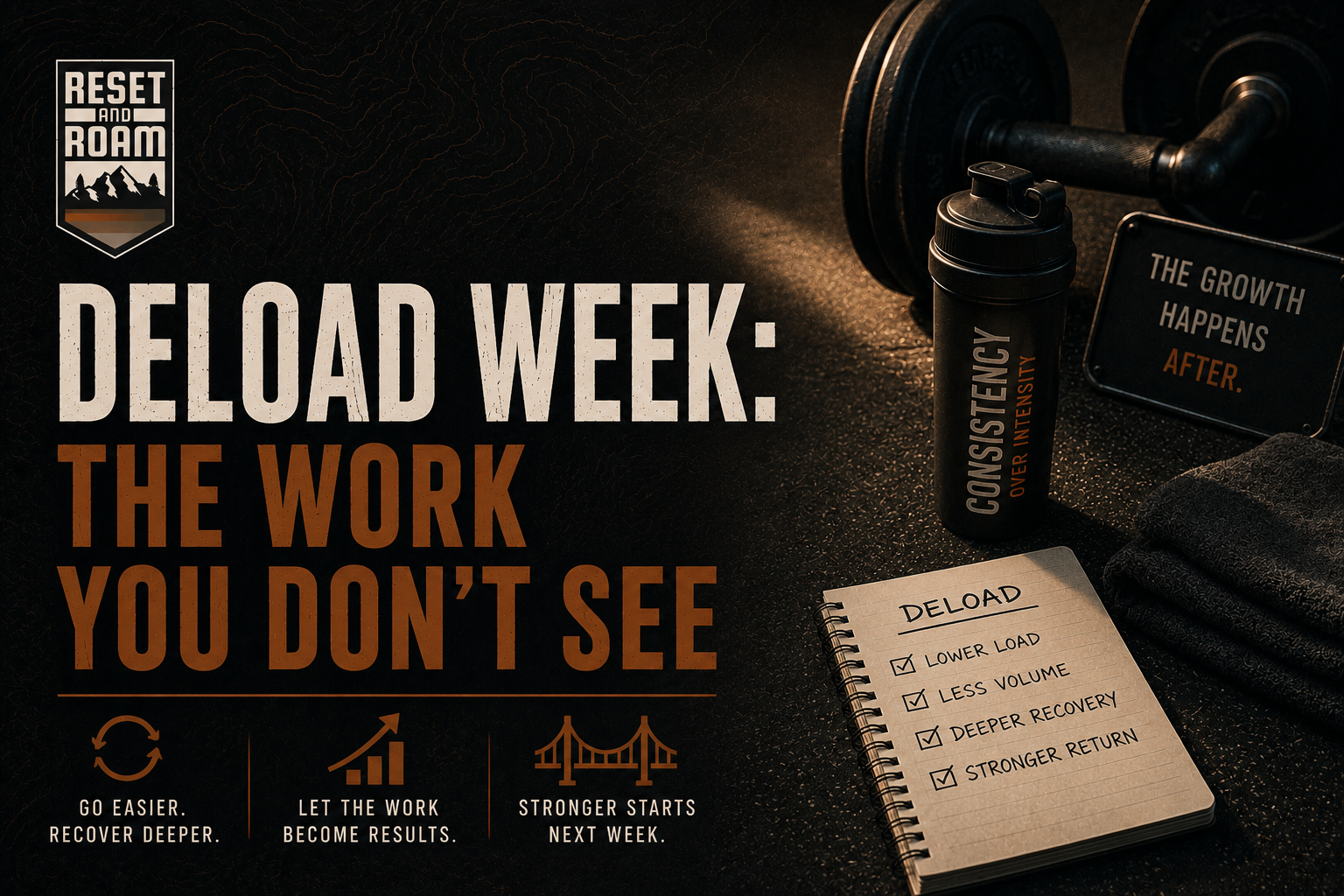
Here's what most people get wrong about a deload. They think it means taking time off. It doesn't. I'll be in the gym every morning next week, same as always. The streak stays alive. What changes is the load.
Volume drops by half after the warm-up set. If I normally run four working sets, I run two. Load drops 10 to 15 percent across every exercise. Rep ranges compress the same way — I keep the structure but drop the bottom half. Any pump set or failure set gets cut entirely. Think of it this way: the stimulus stays present, the damage gets dialed back. Sleep becomes a priority too — I keep my bedtime, but I let myself wake up naturally. If that means training after work instead of before, that's what happens.
The streak isn't about intensity. It's about consistency. Protecting the habit is the whole point.
Here's the thing that took me a while to actually believe: the growth doesn't happen in the gym. It happens after. The workout is the stimulus. The adaptation — the muscle, the strength, the progress — that happens during recovery. You don't build in the gym. You break down in the gym. You build in the hours after, when the body repairs what you damaged and comes back slightly more capable.
The rest isn't separate from the work. It's where the work finishes.
When you never give it enough time to do that, you're just accumulating damage. I know what that looks like firsthand. In September 2025 I threw myself into a serious bodybuilding program with too much volume built in. Within a couple of weeks my lifts were dropping and I didn't want to go to the gym anymore. I cut back but the damage was done. By late February 2026 I stopped going entirely. Two months out. I told myself I was working on other goals. The truth is I burned myself out and it cost two months of progress and I lost 4.6 lbs of muscle — dropping from 123.7 lbs of skeletal muscle to 119.1 lbs.
If I'd known this earlier, a deload week was all it would have taken to prevent it.
A deload week is when all the work from the previous four weeks actually becomes results. The fatigue dissipates. The adaptations express themselves. That's not rest from progress. That's when progress lands. Burnout doesn't give you time off on your terms — it takes time off from you, on its own schedule, when you have no say in the matter.
Going easier next week isn't the soft choice. It's the disciplined one.
Deload week is also the bridge between cycles. I'll pull the Hume Pod data, review the training log, identify what worked in Cycle 1 and what didn't, and build Cycle 2 around what the numbers actually tell me. Nutrition shifts too — protein holds constant, calories drop slightly to match the reduced training load. It's not a free week. It's a recovery week with the right fuel for what the body is actually doing. And if the science holds — and it does — the first week back in Cycle 2 will be the strongest week I've had yet. The fatigue that's been masking the fitness gets out of the way. This is the part most people never see because they never stop long enough to let it happen. I cover all of it in detail in my upcoming book, Strategic Fitness.
I'll be back in the gym next Monday morning. Just not as heavy.
That's the point.