Recovery: The Tools Were in the Closet

At 24, I could train through anything and wake up ready. Two-a-days. Late nights. Poor nutrition. It didn't matter. My body absorbed it and reset.
At 48, two bad nights of sleep show up in my data, my resting heart rate, and my face.
I'm 19 days into 365 days of lifting. And one week ago I was slowly being worn down -- day after day, session after session -- by the thing that ends most comebacks. Not injury. Not motivation.
Fatigue.
This is the story of what I did about it. And what I wish I had done on Day 1.
A Note Before We Go Further
I'm a man who loves this stuff and I'm willing to experiment on myself. What works for me might not work for you -- or might not be in your best interest. If anything in this post inspires you to make a change, check with your doctor first. I'm here sharing my experience. This is not advice.
What 48 Feels Like
In my 20s, I got sore. But I always had energy. I could go and go and go. I didn't think about recovery because I didn't need to. My body just handled it. Bounced back. Reset overnight. Showed up ready.
I had no HRV data in my 20s. No fatigue scores. No recovery tracking. None of it existed in my world. And honestly, it didn't matter. The body was doing it on its own.
At 48, training six days a week, the body is not doing it on its own anymore. I can feel the accumulation. Day after day, session after session, the fatigue doesn't fully clear. It stacks. By Day 14 it had a weight to it that I couldn't ignore anymore.
That's not a complaint. That's the reality of doing serious work at this age. And understanding that reality is what separates the men who make it to Day 365 from the ones who burn out somewhere in the middle.
When Recovery Finally Clicked
Here's something I'll admit that I probably shouldn't have to admit this far into my fitness journey.
Recovery clicked for me about six months ago.
Not the concept of it. I understood recovery conceptually for years. Rest days. Sleep. Hydration. I knew the words.
What clicked six months ago was the actual mechanism -- that the gym is not where the muscle gets built. The gym is where you break the muscle down. The building happens after. During recovery. While you sleep. While the body uses the nutrition you gave it to rebuild what you damaged and add a little more on top.
The gym is the stimulus. Recovery is the response. And the response is the whole point.
I've been spending years focused on the stimulus and treating the response like an afterthought.
Nutrition works the same way. You break it down in the gym. You rebuild it in the kitchen. You reveal it through recovery.
All three. In that order. Every time.
For me the goal is a competition physique -- and you can't reveal what you haven't built, and you can't build what you haven't recovered.
The three pieces form a system. Training breaks the muscle down. Nutrition provides the building blocks. Recovery is where the building actually happens. Remove any one piece and the whole system breaks down.
I believe this is what ends most fitness campaigns for men our age. They start training hard. The fatigue builds. They wake up so sore and tired they skip a day. One day becomes two. Two becomes four. The streak dies -- not because the training was too hard, but because the recovery wasn't there to support it. They blame the training. It wasn't the training. It was the recovery.
If the fatigue builds too fast and the recovery can't keep pace, I'll have to cut back. The protocol isn't optional maintenance -- it's what allows me to keep the current pace without the whole thing collapsing.
I wish I had taken my own advice seriously from Day 1. I would have saved myself from unnecessary pain and sessions that were never as productive as they should have been.
Reading the Data
I track several metrics every morning. Not because I'm obsessed with numbers -- because the numbers tell me things my body isn't always loud enough to say. Here's what I track, what each one means, and what I'm looking for.
Heart Rate Variability (HRV)
HRV measures the variation in time between each heartbeat. Counter-intuitively, more variation is better -- it means your nervous system is flexible and responsive, not locked in a stress state. A higher HRV means your body is recovered and ready. A lower HRV means it's still working to catch up.
On Day 14 my HRV was 45ms against a baseline of 47ms. Below baseline. My nervous system telling me it hadn't fully reset from the week. By Day 17 and 18 -- midweek, when fatigue really starts stacking -- my HRV was holding at its midline instead of trending downward the way it was before I started the protocol. That's the feedback loop I was looking for. That's proof the recovery is working.
One critical thing to understand about HRV: the number itself doesn't matter as much as the trend. My numbers mean something specific to my body. Your numbers will be different. A reading on an Apple Watch is not the same as a reading on a Garmin -- different devices measure differently. What matters is how your number moves over time relative to your own baseline. You are measuring yourself against yourself, not against anyone else's benchmark. You need at least three data points before a trend means anything, and those weekly trends need to become monthly before the data gets truly useful.
I track HRV through Apple Health and use an app called Athlytic to get a cleaner view of the trends over time.
Resting Heart Rate (RHR)
RHR is how many times your heart beats per minute at complete rest. Lower is generally better for trained athletes -- it means your heart is efficient. When RHR climbs, it's a signal of accumulated fatigue, illness, or poor sleep.
On Day 14 my RHR was 75 bpm. Elevated. Combined with the HRV drop, it confirmed what I already felt -- I was carrying more fatigue than I should be. Since starting the protocol, I'm waking up with a lower, more stable resting heart rate. The numbers are moving in the right direction.
Respiratory Rate
This is how many breaths you take per minute during sleep. Normal range for most adults is 12 to 20 breaths per minute. When it climbs during sleep, it can indicate the body is working harder than it should -- stress, illness, or disrupted sleep quality.
Mine has been sitting at 11.4 breaths per minute -- just below the standard adult range of 12 to 20. Worth watching but not alarming given this is a wearable sleep measurement rather than a clinical reading.
Blood Pressure
I have high blood pressure. I don't hide it -- I manage it. I use a Withings blood pressure monitor at least three times a week. My May average was 127/79, ranging from a low of 119/76 to a high of 139/82. During heavy training blocks, blood pressure can creep up as another signal the body is under load. I watch the direction it moves, not any single reading.
If you have high blood pressure -- and a lot of men our age do, whether they know it or not -- this is the one metric you can't afford to ignore. Get a cuff. Track it. Know your numbers. Then talk to your doctor about what they mean.
How I Use the Numbers
Here's how I use the numbers once I have them.
When my HRV is normal or elevated -- I train as planned. Full protocol in the evening.
When my HRV is down roughly 20% from my baseline -- I reduce my training volume. I skip the EMS. Theragun and GOWOD only. I prioritize sleep above everything else.
When my HRV is severely suppressed -- I walk. Mobility work. Nothing hard. Full Sunday protocol regardless of what day it is.
The number isn't just data. It's a daily decision.
How to Get This Data
You don't need every device I use. Here's how to start.
Apple Health already captures HRV, resting heart rate, and respiratory rate if you have an Apple Watch. It's all there -- most men just never look at it. Athlytic gives you a cleaner trend view. Garmin and Suunto capture similar metrics in their own apps. The numbers differ between platforms, which is exactly why you track trends not single data points.
For blood pressure, I use the Withings monitor. If you're managing blood pressure, a dedicated cuff is worth the investment.
Before and After
Day 14 I woke up drained. HRV below baseline. Resting heart rate elevated. Two bad nights of sleep sitting on top of two weeks of accumulated fatigue. I knew something was wrong before I looked at a single number.
Day 19 I woke up sore but ready. HRV holding. Sleep window protected. The fatigue is still there -- I'm training six days a week, it doesn't disappear -- but it's manageable instead of crushing. There's a difference between tired and worn down. One week of the protocol and I can feel that difference.
The Enemy at Day 14
I wrote a post once about environment -- about how if you want to change your behavior, you have to change your surroundings first. That the path of least resistance determines what you actually do, not your intentions.
I believe that.
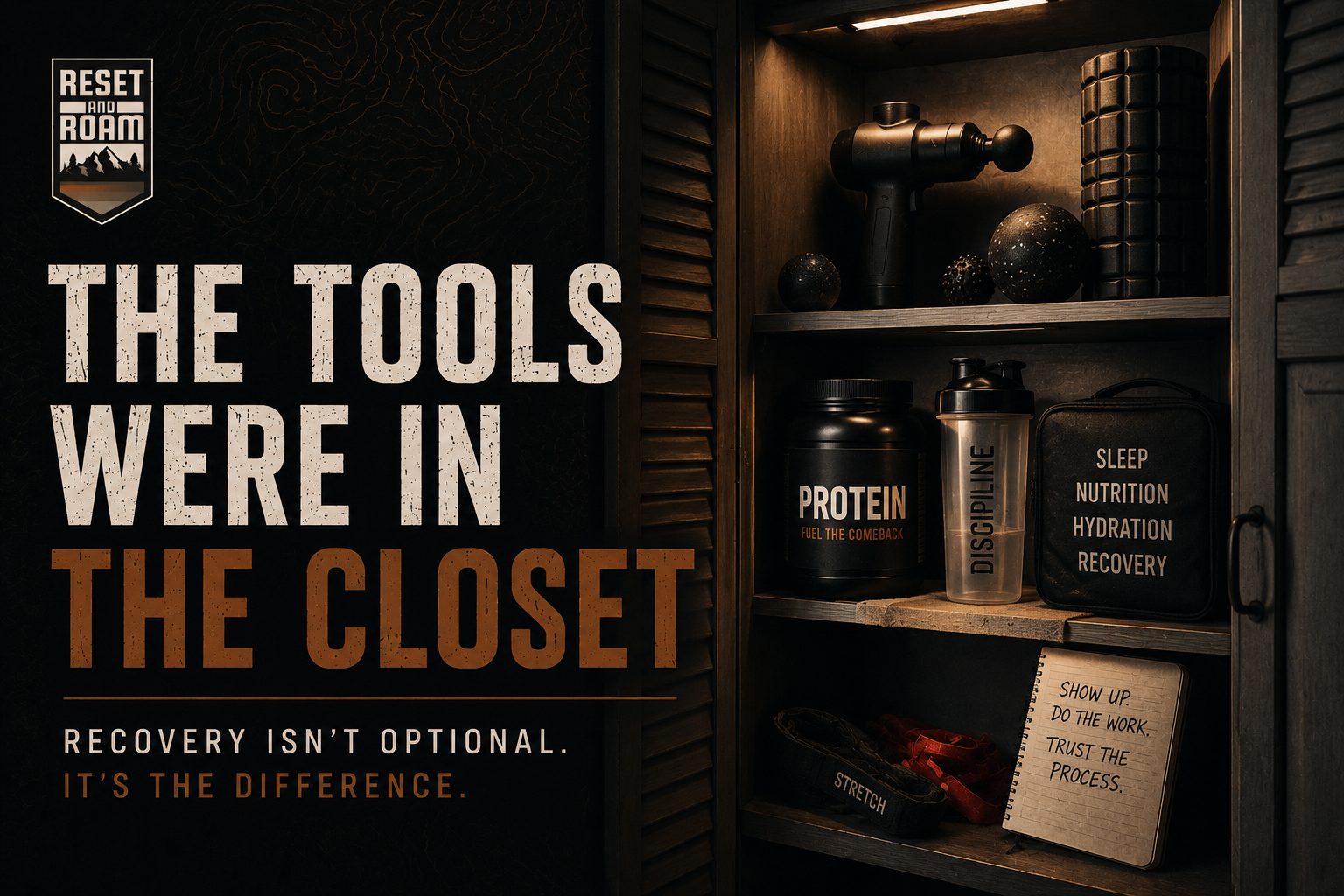
On Day 14 I realized my recovery tools were in the closet.
The Theragun. The Theracups. The HiDow. The Sirkel. All of it. In the closet while the TV sat in the living room.
Every evening after training I came home, made dinner, maybe went for a walk, and sat down in front of the TV. And the tools sat in the closet because getting them out took more effort than picking up a remote. No plan. No clear understanding of what each tool was actually doing. No sense of what to expect the next day. So the easiest thing won every night.
That's not a willpower problem. That's an environment problem.
And I know better. I literally wrote about this.
That's the gap nobody talks about. The distance between knowing something and actually living it. Information doesn't change behavior. Environment does. And I hadn't changed the environment.
Sitting at SweatHouz on Day 14, tired, drained, looking at the data on my phone -- that's when it landed. The man who had written about changing your environment to change your behavior caught himself living in the wrong one.
The tools had been available for months. The plan was what was missing.
There Is No Such Thing as an Empty Hour
Here's the thing nobody tells you when you decide to add something new to your life.
Every hour is already full.
It may be filled with watching TV. It may be dinner with the family. It may be scrolling your phone without thinking about it. But every hour has something in it. When you start something new you are not filling an empty space -- you are displacing something that was already there. And that transition from one thing to another takes time to become automatic.
On Monday of this week I was trying to do two things at once -- wind down from the day and start the recovery protocol. By Thursday I was only focused on the recovery. The TV wasn't competing anymore. The protocol had become the thing.
That transition took four days. And the protocol took longer than planned every single day while it was happening.
On Sunday my full recovery session took twice as long as it will once I have the process dialed. I'm still getting used to the tools -- where to place the HiDow pads, how long to run each section, which muscles need more attention on which training days. The first week of any new protocol is not the protocol working at full efficiency. It's the protocol being learned.
If you're starting something new, give yourself double the time you think you need. Not because you're slow. Because there is no such thing as an empty hour and the transition is real.
What the Protocol Actually Looks Like
Here's what I'm doing every evening after training. Not the ideal version. The real version as of Day 19.
I start with the Theragun. I use the guided workout in their app, but if you don't have a Theragun the principle is simple -- one minute on each muscle group you trained that day. Yesterday was back and biceps. Upper right back, one minute. Upper left back, one minute. Mid-back left, one minute. Mid-back right, one minute. Lower back left, one minute. Lower back right, one minute. Right bicep, one minute. Left bicep, one minute.
Then the Theracups on the left and right erector muscles -- one minute at each section.
Then the HiDow EMS -- five minutes on the upper back, five minutes on the lower back.
Then the daily GOWOD workout. Whatever the app prescribes. Fifteen minutes.
Total time yesterday: 40 minutes. That's longer than the 20 to 30 I planned. It'll get there. Right now I'm still learning the process.
On Sundays the full protocol runs about two hours -- an hour at SweatHouz for contrast therapy, then 60 minutes at home working head to toe. Sunday night into Monday morning is when my HRV is consistently highest. I wake up Monday feeling refreshed and motivated in a way I didn't before the protocol existed.
By Day 17 and 18 -- Push Day and Pull Day, when the fatigue is really starting to stack -- the soreness is manageable instead of punishing. The difference is noticeable. Not subtle. Noticeable.
Sleep Is the Foundation Everything Else Sits On
I can do every therapy in the protocol correctly and still lose the recovery battle if I don't protect my sleep.
This week I set alarms to start my wind-down process at a consistent time every night. I built a schedule. I'm not perfect -- but I'm working to stay within a 30-minute window of the same bedtime and wake time every day. That consistency matters more than any single long sleep session.
The data backs it up. When my sleep window holds, my HRV holds. When my sleep gets disrupted, everything else follows.
If You're 48 and Starting From Zero
If none of the tracking I described is part of your life yet, here's where I'd start. Not with the Theragun. Not with contrast therapy. Not with HRV monitors.
Start with sleep.
The simplest starting point is an app called Sleep Cycle. Download it tonight. It listens while you sleep and tracks when you fall asleep, when you wake, how many times you get up, whether you're snoring. No watch required. Just your phone on the nightstand.
If you don't want an app, use pen and paper. Every morning write down three things: what time you went to sleep, what time you woke up, and a score from one to five for how refreshed you feel. Five means you woke up ready. One means you slept horribly. Track how many times you got up during the night. I do this myself. Most mornings I'm a three. The week before I started the protocol I was consistently a two.
If you have nothing -- no tools, no devices, no apps -- start with ten minutes of walking after your workout and a pen and paper sleep log. That's the minimum viable protocol. Everything else builds on top of it.
Once you have a few weeks of sleep data and want to go deeper, the next step is a wearable. I prefer Apple Watch for the depth of health metrics it captures. A Fitbit works. A Garmin works. What matters isn't the brand -- it's that you start building your trend. Not someone else's numbers. Yours.
Sleep first. Data second. Tools third.
What I'm Still Figuring Out
One week in, I'm not going to pretend I have this solved.
The protocol is working. The data shows it. The way my body feels shows it. But I'm still learning the tools, still dialing the timing, still building the habit the same way I built the training habit -- one imperfect day at a time. Miss a day -- get back on the next one. No penalty. No restart. Just continue.
The feedback loop is starting to form. Do the work Sunday night. Wake up Monday ready. Protect the sleep window Thursday. Hold the HRV midline Friday. The cause and effect is becoming visible.
That's what I needed. Not perfection. Evidence.
I'm not going to promise you a transformation by Day 90. The goal at Day 90 is simple -- to have shown up for the other 89. Consistently. Without the fatigue winning. That's what the recovery protocol is protecting. Not a number on a scale or a measurement on a tape. The ability to keep going.
In Strategic Fitness I write that the enemy to fitness and health is fatigue. I believed that when I wrote it.
I just didn't take my own advice seriously enough to fight it.
The tools were in the closet. The plan was missing. The hours were already full of easier things.
One week of doing the work differently and I can feel the difference in my body, see it in my data, and prove it in the gym.
Where are your tools right now?
Day 19 of 365 days of lifting. Follow the series on Instagram @just_roper_fitness