Why You're Not Getting Results (It's Not Your Effort)

In January 2024, I weighed 251 pounds. By mid-year, I weighed 262.
I trained regularly. I ate reasonably. I showed up. And the number went in the wrong direction anyway, not because I quit, not because I stopped caring, but because I had effort without a plan underneath it. I had workouts. I did not have a campaign.
That distinction is the difference between spinning and moving.
Sun Tzu opened The Art of War with a line that fitness culture has largely ignored for two thousand years:
"The general who wins makes many calculations before the battle. The general who loses makes few."
He was not writing about motivation. He was not writing about effort. He was writing about what happens before action begins, the planning, the structure, the defined objective, and arguing that victory is largely decided there. Not in the field. Before the field.
Fitness works the same way. Results are largely decided before the first workout begins.
Most men come at this backwards. They start with action. They find a program, they commit to the gym, they clean up their diet, and they measure success by how hard they worked. Effort becomes the proxy for progress. And when the results don't match the effort, the conclusion is always the same: I need to try harder.
That conclusion is almost always wrong.
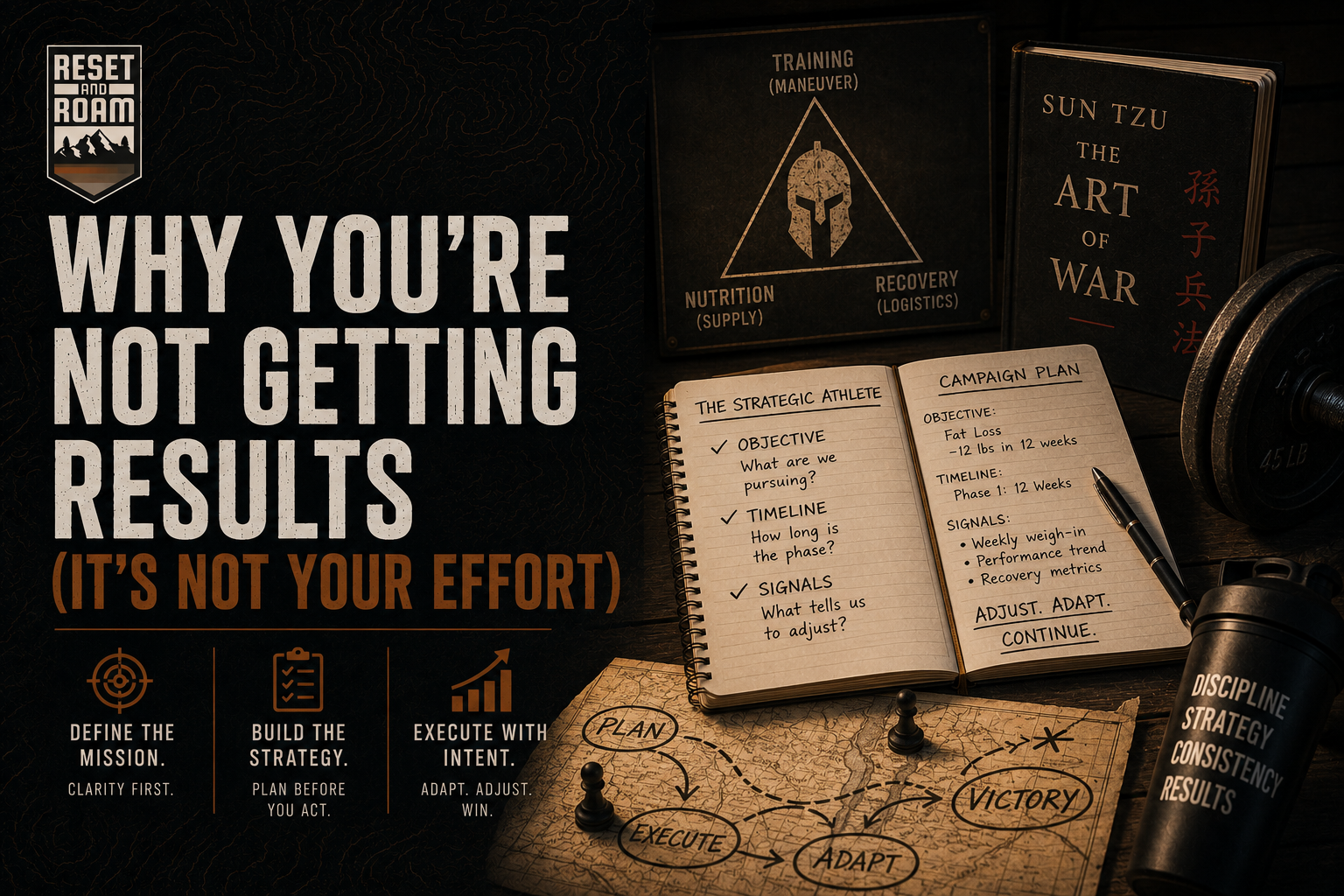
A strategic athlete answers three questions before starting a phase. Not while training. Before.
What specifically am I pursuing?
Not "get in shape." Not "lose some weight." A defined, measurable objective with a direction and a number. Fat loss at a specific calorie target. Strength progression on specific lifts. A competition date. The objective has to be precise enough that you can tell, at any point, whether you're moving toward it or away from it.
In 2024, I had none of that. I had intentions. Intentions are not objectives. They are objectives without architecture, and they collapse the first time life gets complicated.
How long will this phase last?
An open-ended plan is a plan with no accountability structure. When does the current approach end and the assessment begin? If the answer is "until I feel like things are working," the plan will run as long as motivation does, which is not very long, and not very consistently.
A defined phase has a duration. Twelve weeks. Sixteen weeks. A competition date that forces the math backward into the calendar. The timeline creates the container. Without the container, effort dissipates.
What signals tell me the plan is working or needs to change?
This is the question almost nobody asks. What does a stall look like? What's the trigger to adjust nutrition? What does two consecutive weeks of declining performance on a primary lift mean, and what's the response?
I learned what happens without a pre-decided answer to that question in early 2026. Four months into a new training plan, my lifts were going down, my HRV was in the toilet, and I was worn out in a way that didn't feel normal. The signals were real. I could see every one of them. But I had no protocol for what they meant or what to do about them. So I did what most men do when the plan stops working and there's nothing underneath it: I walked away. That led to weeks of inconsistent training and some weeks with no training at all.
The signals weren't the problem. The absence of a pre-decided response was.
Without that, every setback becomes a crisis managed by emotion. With it, the same signals become a trigger for a protocol: reduce volume, protect sleep, reassess in two weeks. The difference between those two things, across a six-month campaign, is the difference between a setback and a derailment.
Here is the mental model that changed how I approach this:
Training is maneuver. Nutrition is supply. Recovery is logistics.
Most men have workouts. Strategic athletes have campaigns.
A workout is a single engagement. It can be hard, it can go well, it can produce real effort, and it can still be moving you away from the objective if there's no strategy underneath it. Maneuver without supply fails. Supply without logistics collapses. And all of it fails without a defined mission to orient around.
The plan does not have to be complex. But it has to exist, in writing, not just in your head. A plan that exists only in your head is not a plan. It is an intention. Intentions feel like plans until the moment they meet pressure.
I know what it feels like to work hard and watch the number climb. To put in genuine effort and still not move in the right direction. To look at the chart and have no explanation for it beyond "I didn't try hard enough," which is both untrue and demoralizing.
The problem, in my case, was not effort. It was the absence of planning that made the effort mean something.
That is what this series is about. Not motivation. Not harder training. Strategy, applied to fitness the way Sun Tzu applied it to warfare: with structure, with defined objectives, with pre-decided responses to changing conditions, and with the honest acknowledgment that effort alone has never been enough.
The book that builds this out in full, Strategic Fitness, drops in August. It maps all thirteen principles of Sun Tzu's Art of War directly to the problems that actually stall progress: planning failures, resource mismanagement, ignoring terrain, operating without intelligence. One principle per chapter. Every one of them applied to exactly the kind of long-term fitness campaign most men never build. If this post landed, the book is the rest of the framework.
Next Friday: what it actually costs to run a campaign, and why most athletes go broke before the results arrive.