The Little Voice

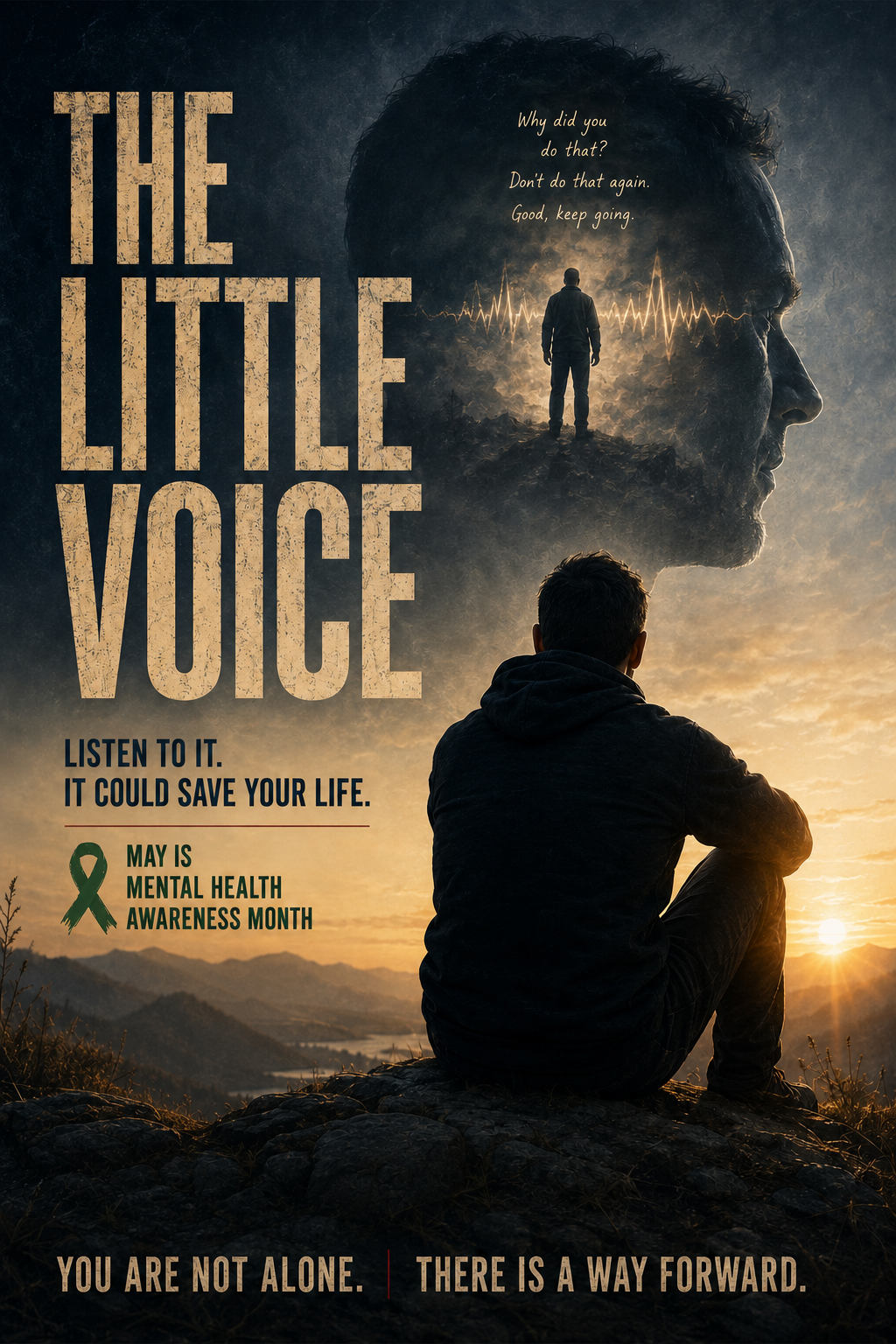
There is a man reading this right now who knows something is off. He has known it for a while. He hasn't said it out loud to anyone, and he probably won't — not today, maybe not ever. He's not weak. He's not broken. He just hasn't had a reason to believe that saying something out loud would do anything useful.
This is for him.
And if that's not you — if you're reading this and you're okay — keep reading anyway. Because there is a good chance you know someone who isn't.
May is Mental Health Awareness Month. I'm not going to walk you through statistics or tell you why mental health matters. If you're reading this, you already know something matters. You're just not sure what to do with that.
I want to tell you what I know. Not from a textbook. From a life.
I spent over ten years as a firefighter paramedic. In that world, mental health is not a conversation that happens easily. What gets modeled is getting back on the engine. What gets rewarded is not needing anything.
One day, while I was on duty, word came to the firehouse that a battalion chief had gone missing. He was found later, lifeless in his truck. I knew him from earlier in my career. When I first came into the fire service, green and still learning everything, he was one of the people who took the time to teach me the ropes. I admired him. The news stopped me cold. There are too many stories like that.
I remember a call involving a child that still haunts me today. It was the kind of call that makes you ask, "Why does any of this matter?" Is any of this worth the trouble? At the time I didn't have the words for what I was feeling. It wasn't that I refused to speak. I genuinely didn't know what to say.
That silence has a cost. I watched it collect.
Years passed. I kept moving. That is what you do.
I was in my late thirties when I was finally diagnosed.
I have a mental illness. I am Bipolar Type I.
The day I was diagnosed was one of the hardest days of my life. I was standing in a store when my mind just took off without me. Thoughts everywhere at once. The only way I can describe it, it felt like flying, but I knew I wasn't flying. It felt like anything was possible, and I knew that wasn't true either. I drove myself to the doctor's office.
When the diagnosis came, I was confused. Bipolar had never crossed my mind. I spent the next several months with doctors and therapists, trying to understand what it actually meant.
Here is what television gets wrong about Bipolar disorder: it focuses on the drama. It paints a picture designed to create fear, and that picture does real damage. A man who walks out of a doctor's office with a fresh diagnosis and only has television as a reference point isn't going to seek help. He's going to be afraid of himself.
That's not my story. And it's not the story of most people I know who live with this diagnosis.
Getting the medication right is not a fast process. It took months. But fairly quickly I could sense the possibility, something shifting, something settling. When my doctor and I finally found the right combination, I just knew. The best way I can describe it is a sense of control. Not perfection. Control. For the first time, my mind felt like something I was operating rather than something operating me.
Here is the best way I can explain what Bipolar feels like, and maybe this lands for you even if Bipolar has nothing to do with your life. I have two minds. One mind is operating moment to moment, making decisions, moving through the day. The other mind is watching that mind. It's the little voice. The one that says Why did you do that or Don't do that again or Good, keep going.
When my Bipolar flares, I lose touch with that second mind. I lose the little voice. Without it, my mood can go in one of two directions.
Sometimes it elevates. That state is called hypomania. I feel overly confident. My thoughts move fast, too fast. I start talking quickly. Grandiose thinking sets in and everything feels possible in a way that isn't grounded in reality. Other times my mood drops very low. I become extremely depressed. My thoughts slow down. The world narrows.
There are two types of Bipolar disorder. Type I means a person has experienced full Mania, which is a level above hypomania. Type II is defined by hypomania and depression, and for most people with Type II, depression dominates. The distinction comes down to one thing: if a person has never had a documented Manic episode, they are considered Type II. I am Type I.
The medication keeps me connected to the little voice. It keeps me grounded. I remember what it felt like to not have that connection, and I will do whatever it takes to keep it.
That is not the story television tells. And that story has consequences. When the only version of mental illness you've ever seen is someone coming apart, you don't go looking for answers. You go looking for a way to keep it together on your own. I did that for years. And I know what it costs.
When I was fifteen years old, I attempted to hurt myself.
I'm not sharing that for sympathy. I'm sharing it because I want you to know that I am not speaking from a safe distance. I know what it feels like when the hope drains out.
A friend cared enough to take me to the emergency room. I didn't leave that hospital for two weeks. The shift didn't come from a single conversation with a doctor. It came from the other people there. Sitting with people who were in their worst pain, sharing my story, hearing theirs, I could see healing in them even when they couldn't see it in themselves. That's when I understood that there are better days ahead, even when better days feel impossible to believe in.
I came out of that hospital with two things I didn't have going in. The first was language; I learned that naming your feelings is the first step. The second was something I needed to hear, and maybe you do too: people care. More than you think. People want you to find joy.
I have lived the rest of my life from that understanding.
I'm telling you all of this because that man at the beginning of this post, the one who knows something is off, deserves to hear it from someone who has been there. From the conversations I've had with men, most don't spend much time thinking about their mental health. I don't think that means they don't care. I think it means the behavior has never been modeled in a way that felt useful or respectable. They've never seen a man they respected say something was off, do something about it, and come out the other side looking like someone worth listening to.
So here is what I want to say plainly.
If you have a little voice, listen to it. If it's been telling you something is off, that's not weakness. That's information.
That understanding didn't come easily for me. It came through work, through a program that forced me to look at my own patterns honestly. Dark thoughts are not a verdict on who you are. They are not good or bad. They are feedback. They are a call for help.
If something feels off, reach out. To a doctor, a therapist, a friend, anyone. Mental health professionals are not there to fix you; in my experience, they walk alongside you until you find your own answer.
If the darkness is that deep, if you feel alone and hopeless and like there is no way through, go to the emergency room. That is what it is there for. That is what it was there for me.
And if this isn't you, if you're the one on the outside watching someone you care about struggle, don't give up on them. You don't need the right words. You don't have to fix anything. Just be there. They aren't broken. They just need to know they aren't alone. Sometimes that's everything.
You don't need the words. I didn't have the words at fifteen. I just had a friend who showed up.
Be that friend for yourself. Be that friend for someone else.
If you or someone you know is struggling, help is available 24 hours a day, 7 days a week.
988 Suicide and Crisis Lifeline Call or text 988 www.988lifeline.org
Crisis Text Line Text HOME to 741741 www.crisistextline.org
SAMHSA National Helpline Call 1-800-662-4357 www.samhsa.gov
Veterans Crisis Line Call 988 and Press 1 or text 838255 www.veteranscrisisline.net
NAMI Helpline Call 1-800-950-6264 www.nami.org
International Association for Suicide Prevention www.iasp.info/resources/Crisis_Centres